Address
304 North Cardinal
St. Dorchester Center, MA 02124
Work Hours
Monday to Friday: 7AM - 7PM
Weekend: 10AM - 5PM
Address
304 North Cardinal
St. Dorchester Center, MA 02124
Work Hours
Monday to Friday: 7AM - 7PM
Weekend: 10AM - 5PM
Understanding Modified Sine Wave Inverters: A Comprehensive Guide to Selection and Application
In the realm of off-grid power systems, recreational vehicles (RVs), and emergency backup solutions, the inverter stands as the critical bridge between stored energy and usable electricity. As we navigate the market for these essential devices, a specific term frequently emerges, often sparking confusion among consumers: the Modified Sine Wave Inverter. While the allure of low-cost alternatives is strong, understanding the technical nuances of a modified sine wave inverter is paramount for ensuring the longevity of your appliances and the safety of your electrical setup. This article delves deep into the mechanics of these devices, contrasting them with their “pure” counterparts, and provides a strategic framework for making the right choice for your specific power needs.
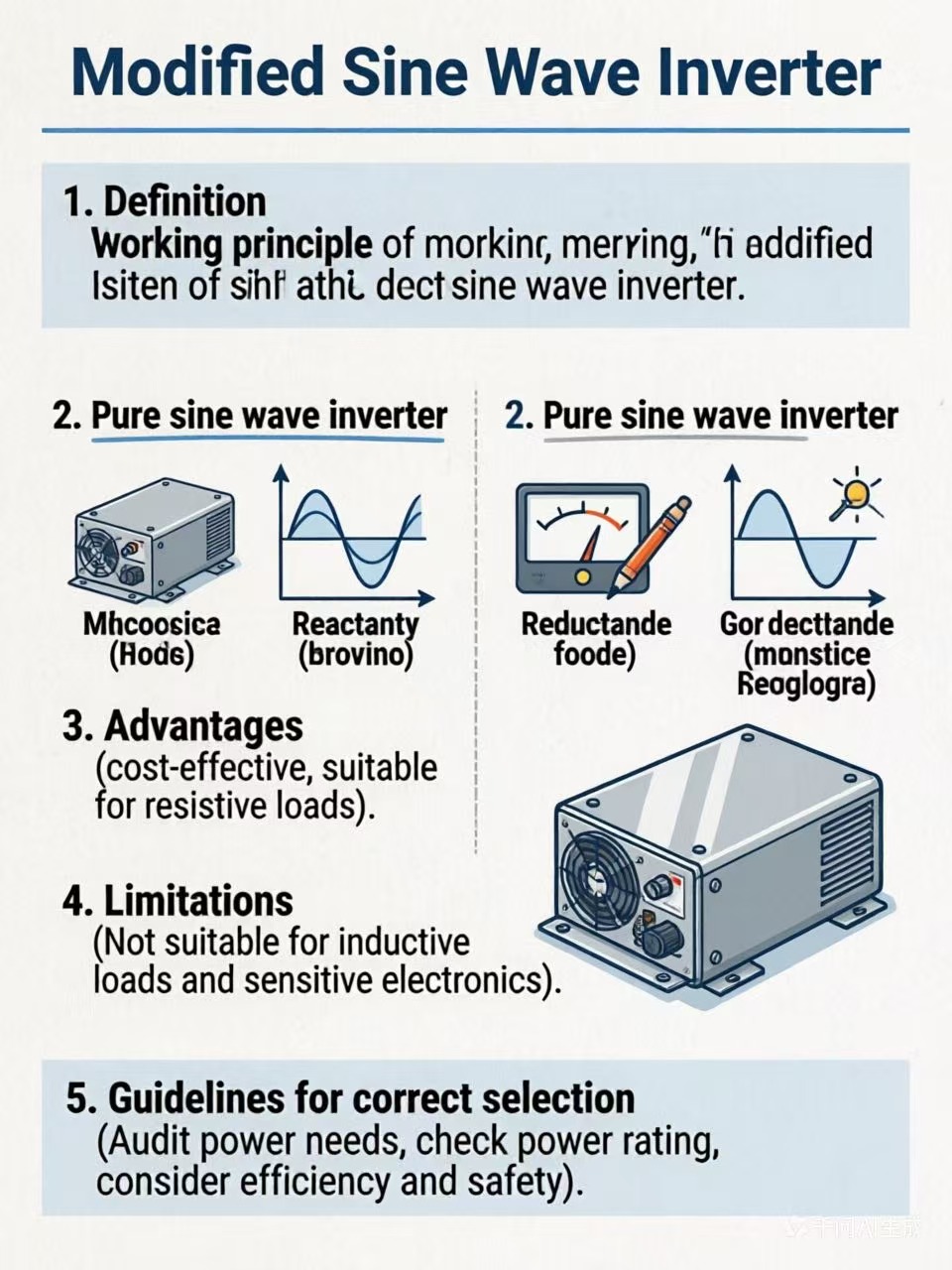
To truly grasp the concept of a modified sine wave inverter, one must first visualize the nature of electricity. The power we draw from wall outlets in our homes is Alternating Current (AC), which flows in a smooth, oscillating curve known as a Pure Sine Wave. This smooth transition is the gold standard for electrical transmission. However, generating this perfect wave from a Direct Current (DC) source, like a car battery, requires complex and expensive circuitry. Enter the modified sine wave inverter. Instead of a smooth curve, this device outputs a stepped waveform that approximates a sine wave. It essentially creates a “staircase” pattern, jumping between positive, zero, and negative voltage. While this output is significantly better than the crude square waves of early inverters, it is electrically “rougher” than utility power.
The primary advantage of the modified sine wave inverter is economic. Due to simpler internal circuitry—often utilizing Pulse Width Modulation (PWM) without the complex filtering found in pure sine wave models—these units are significantly cheaper to manufacture. For budget-conscious users, this price difference can be the deciding factor. Furthermore, for simple resistive loads, they are surprisingly effective. A resistive load is a device that generates heat or light through resistance, such as incandescent light bulbs, basic toasters, or simple electric heaters. In these scenarios, the “stepped” nature of the electricity matters little; the device simply consumes the power and functions as intended.
However, the limitations of a modified sine wave inverter become glaringly apparent when dealing with “inductive loads” or sensitive electronics. Inductive loads are devices that rely on magnetic fields to operate, most notably those with AC motors. This includes refrigerators, air compressors, power drills, and microwave ovens. When powered by a modified sine wave, these motors often run hotter, louder, and less efficiently. The “stepped” waveform causes the motor to vibrate rather than spin smoothly, leading to excess heat generation. Over time, this thermal stress can degrade insulation and shorten the lifespan of the appliance. Additionally, devices with variable speed controls or digital timers may behave erratically, as the inverter’s frequency harmonics can confuse the internal clock of the device.
Sensitive electronics present another challenge. While a laptop power brick might function, audio equipment connected to a modified sine wave source will often emit an audible “hum” or buzzing noise due to electrical interference. Medical devices, such as CPAP machines or oxygen concentrators, generally require the clean power of a pure sine wave to operate safely and accurately. Therefore, the selection process is not merely about wattage; it is about compatibility.
So, how does one correctly select an inverter? The first step is a thorough audit of your power needs. You must categorize your devices. If your application is strictly for camping with a few lights and a coffee maker, a modified sine wave inverter might suffice. However, if you are outfitting a home backup system or a full-time RV, where you will run laptops, medical equipment, or motor-driven appliances, the investment in a Pure Sine Wave inverter is non-negotiable.
Secondly, consider the power rating. Regardless of the wave type, you must calculate the “surge power” or peak power. Motors often require 3 to 7 times their running wattage to start up. If you choose an undersized modified sine wave inverter, it may trip its overload protection immediately upon trying to start a fridge. It is generally recommended to choose an inverter with a continuous rating that exceeds your highest load by at least 20-30%, and a surge rating that can handle the startup spike.
Finally, look at efficiency and safety certifications. While modified sine wave inverters can be efficient (often around 90%), the heat generated by the connected devices can offset these savings. Always ensure the unit has protections against low voltage, over-voltage, short circuits, and overheating.
In conclusion, the modified sine wave inverter occupies a specific niche in the power market. It is a cost-effective solution for basic, non-sensitive applications but carries risks for complex electronics and motor-driven appliances. By understanding the nature of your loads and the quality of power they require, you can avoid the pitfalls of “dirty electricity” and ensure a reliable, safe power supply. When in doubt, the adage “you get what you pay for” holds true; for comprehensive compatibility, the pure sine wave remains the superior choice, but for simple tasks, the modified sine wave inverter remains a practical, budget-friendly tool.